· Category: Alexander Varvarenko, Varamar Shipping, SHIPNEXT
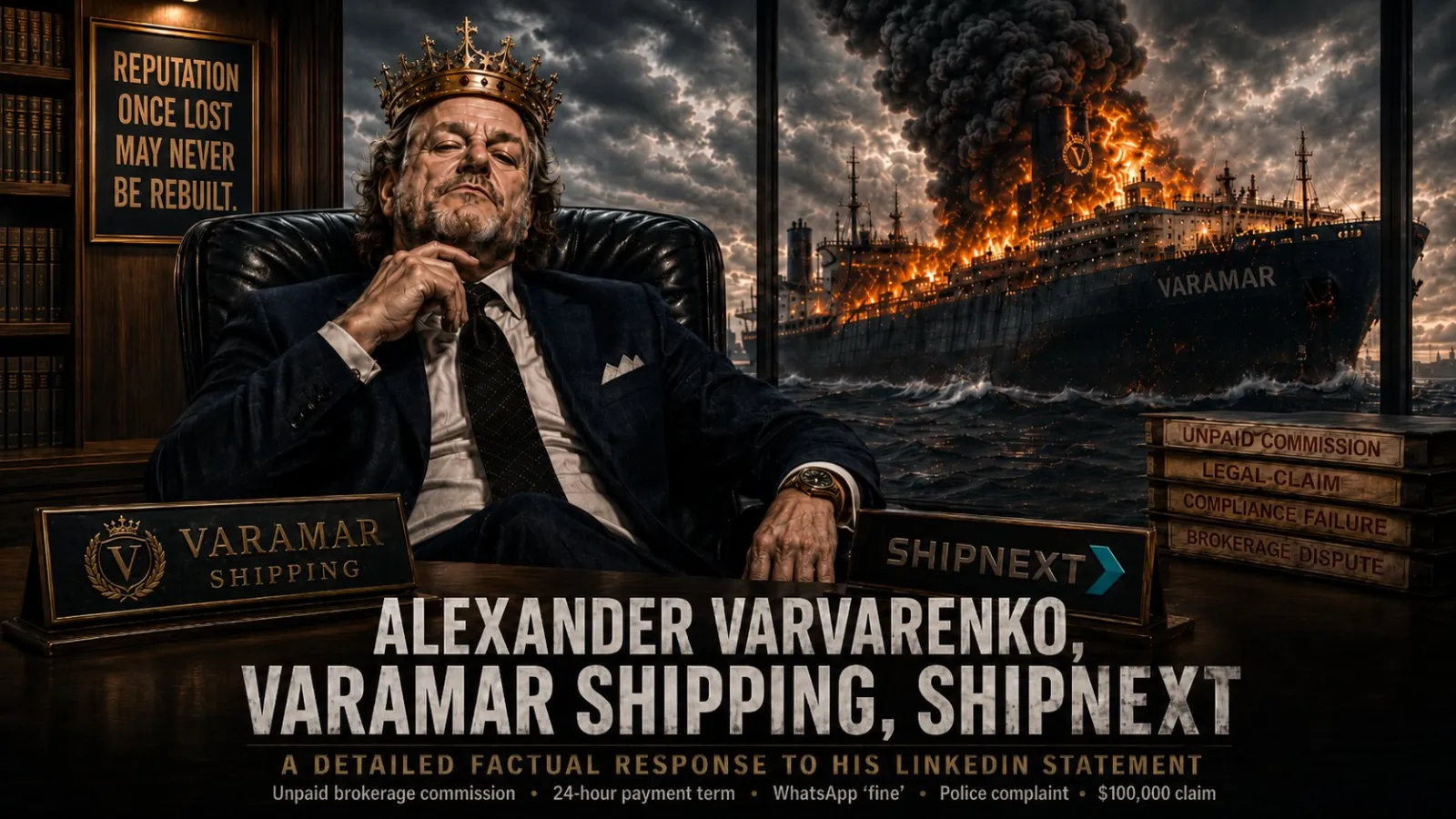
Alexander Varvarenko, Varamar Shipping, SHIPNEXT: A Detailed Factual Response to His LinkedIn Statement
A detailed factual response to Alexander Varvarenko’s LinkedIn statement on the Varamar Shipping brokerage commission dispute, including payment delays, the WhatsApp “fine”, legal threats, court proceedings and an unpaid bunker invoice allegation.
Introduction
Alexander Varvarenko has now publicly commented on the commercial dispute involving Varamar Shipping and an independent broker.
The self-styled and cowardly “mentor” blocked me on LinkedIn many months ago. As a result, I could not see his statement directly when it was published. I learned about it only later, through third parties who brought the publication to my attention.
That is why this response comes with some delay.
Now that I have reviewed Alexander Varvarenko’s statement in full, it deserves a detailed factual answer.
In his LinkedIn post, he claims that allegations concerning Varamar, SHIPNEXT and himself are “false and have no factual basis.”
Yet in the same statement he expressly acknowledges that there is an underlying “contractual/commercial disagreement.”
That contradiction cannot simply be ignored.
If there is a genuine contractual and commercial disagreement, then there is necessarily a factual background to it. There was a commercial relationship. There was brokerage work. There were agreed terms. There was correspondence. There was a payment mechanism. There were requests for payment. There were subsequent actions when payment did not follow.
The real question is therefore not whether facts exist.
The question is what those facts are and what the documents show.
This response is not about somebody’s claimed 25-year reputation, Varamar’s 17-year history, personal image, family status or corporate public relations.
It is about a specific commercial sequence.
The brokerage work was performed.
Varamar received the money from the underlying transaction.
According to the agreed terms relied upon by the broker, the brokerage commission was payable within 24 hours after receipt of the relevant funds.
Payment did not follow.
There was a prolonged period of waiting.
Explanations followed: there was allegedly no money; the Odessa office was allegedly sitting without money; payment would supposedly come “next week.”
Alexander Varvarenko was approached personally twice.
The commission remained unpaid.
Only after that was the technical notice “VARAMAR DOESN’T PAY” published.
Then came Alexander Varvarenko’s WhatsApp message imposing what he called a “fine” equal to 100% of the unpaid brokerage commission.
Then came a threat of reputational/legal action.
Then came a police complaint portraying the broker as an extortionist.
Then came a civil claim equivalent to approximately USD 100,000.
And during the escalation, Alexander Varvarenko’s wife also contacted the broker with threats concerning his social-media presence.
That chronology deserves answers.
Not slogans.
Not reputation management.
And not a blanket statement that everything is “false.”
1. “The allegations are false and have no factual basis”
This is the central statement in Alexander Varvarenko’s publication.
It is also the statement that requires the most scrutiny.
He does not identify one particular date that is supposedly false.
He does not identify one allegedly fabricated message.
He does not identify one document that he says is forged or inaccurate.
He does not identify one specific factual statement and explain why it is wrong.
Instead, everything is dismissed collectively as “false and without factual basis.”
That is not a factual rebuttal.
It is a blanket denial.
And the denial immediately conflicts with his acknowledgment that there is an underlying contractual/commercial disagreement.
If a contractual disagreement exists, then obviously there is a factual foundation to the relationship and the dispute.
The relevant questions are straightforward.
Was brokerage work performed?
Was the voyage fixed?
Did Varamar receive the money arising from the transaction?
Was brokerage commission agreed?
What were the agreed payment terms?
When was payment supposed to be made?
Was it made?
What explanations were subsequently given?
What communications followed?
These are factual questions.
They require factual answers.
2. The work was performed
The dispute did not begin with a speculative demand for money.
The broker’s position is that the brokerage work had already been performed.
The underlying commercial transaction had already taken place.
The work giving rise to the brokerage commission was not something promised for the future.
It had been completed.
This distinction matters.
A demand for payment after completed brokerage work is fundamentally different from an attempt to obtain money without an underlying commercial service.
If Alexander Varvarenko disputes that the brokerage work was performed, he should say so directly and explain which part of the brokerage activity he disputes.
His LinkedIn statement does not do that.
3. Varamar received its money
The next central point is equally simple.
According to the documented chronology relied upon by the broker, Varamar received the relevant funds from the underlying commercial transaction.
That is the point at which the agreed mechanism for payment of the brokerage commission became critical.
The broker’s position is that payment of the commission was due within 24 hours after Varamar received the relevant money.
Therefore the question is not abstract.
If Varamar received its money, what happened to the brokerage commission that was supposed to follow?
Alexander Varvarenko’s LinkedIn statement does not answer this.
4. The 24-hour payment term
According to the commercial terms relied upon by the broker, the commission was payable within 24 hours after receipt of funds.
That provision creates a very clear timeline.
Money received.
Twenty-four hours.
Brokerage commission paid.
But that did not happen.
Instead, the payment remained outstanding for a prolonged period.
If Alexander Varvarenko believes the 24-hour payment term did not apply, this is precisely the kind of contractual issue that could have been addressed in his public statement.
He could have stated the contractual basis.
He did not.
5. There was prolonged waiting before anything became public
One of the most important facts in understanding the dispute is that public criticism did not immediately follow the missed payment.
There was waiting.
There were payment requests.
There were explanations.
There were assurances.
The broker did not immediately turn a commercial payment delay into a public campaign.
According to the broker’s record of the communications, explanations included statements to the effect that there was no money, that the Odessa office was sitting without money, and that payment would supposedly be made “next week.”
These explanations matter because they are difficult to reconcile with a later narrative suggesting that the claim itself had no factual basis.
If nothing was payable, why discuss when money might become available?
Why say “next week”?
Those are questions arising directly from the sequence of communications.
6. Alexander Varvarenko was approached personally twice
Before the dispute escalated publicly, Alexander Varvarenko was approached personally.
Not once.
Twice.
The purpose was straightforward: to resolve the payment issue.
That is important because it undermines any impression that the broker bypassed ordinary communication and immediately tried to create reputational pressure.
There were direct attempts to resolve the matter.
The commission nevertheless remained unpaid.
Only after those attempts failed did the dispute move into the public domain.
7. “VARAMAR DOESN’T PAY” was a consequence, not the beginning
Eventually a technical public notice appeared:
“VARAMAR DOESN’T PAY.”
Alexander Varvarenko’s current narrative places heavy emphasis on the subsequent publications and reputational consequences.
But chronology matters.
The notice did not create the unpaid commission.
The unpaid commission preceded the notice.
The broker waited first.
Requested payment first.
Received explanations first.
Approached Alexander Varvarenko personally first.
The publication came afterwards.
Therefore, any serious examination of the conflict must begin with the commercial payment issue, not with the subsequent public reaction to it.
8. The WhatsApp “fine” equal to 100% of the commission
This is perhaps the most important point Alexander Varvarenko’s LinkedIn statement does not explain.
After the technical notice was published, Alexander Varvarenko personally sent a WhatsApp communication in which, according to the preserved correspondence, he imposed what he described as a “fine” equal to 100% of the brokerage commission.
This raises an obvious question.
If there was never any legitimate brokerage commission payable, what exactly was being “fined”?
A 100% fine equal to the commission appears, at minimum, difficult to reconcile with the later blanket claim that the underlying allegations had “no factual basis.”
There appear to be two fundamentally different propositions.
One proposition would be that the commission was never due.
Another proposition would be that the commission existed but was withheld as a punishment.
Those are not the same position.
If the second position was communicated through WhatsApp, it deserves a clear explanation.
9. The reputational/legal threat
The WhatsApp “fine” was followed by a threat involving reputational or legal consequences.
Again, the chronology matters.
The original question was whether an earned brokerage commission would be paid.
Instead of receiving payment, the broker found himself facing escalating pressure after publicly stating that Varamar was not paying.
A threat of litigation does not determine whether the underlying payment obligation existed.
Neither does a threat concerning reputation.
The contractual question remains exactly the same.
Was the commission payable?
If not, why not?
That is what requires an answer.
10. The police complaint and the allegation of extortion
The dispute subsequently escalated to a police complaint in which the broker was portrayed as an extortionist.
That is a serious allegation.
But demanding payment of an allegedly earned brokerage commission does not automatically become extortion simply because the debtor disputes the demand.
The commercial issue must first be examined.
Was there brokerage work?
Was commission agreed?
Did the relevant payment event occur?
Was payment then withheld?
If Varamar believed that no commission was payable, it could state its contractual reasoning.
A police complaint does not itself resolve that commercial question.
Nor does it erase the earlier correspondence concerning payment.
11. The approximately USD 100,000 civil claim
The conflict then moved into civil proceedings in Ukraine.
A claim equivalent to approximately USD 100,000 was brought against the broker.
That litigation is part of the public chronology.
But it is equally important to state what happened procedurally.
The Solomianskyi District Court of Kyiv closed the civil proceedings on jurisdictional grounds.
The court did not reach a judgment finding that the publications were false.
The court did not determine the underlying brokerage commission dispute on its merits.
Alexander Varvarenko subsequently appealed.
Therefore, the existence of litigation cannot accurately be presented as a judicial determination that the broker’s factual position was false.
There has been no such determination.
12. “We will not conduct a commercial or legal dispute through social media”
Alexander Varvarenko writes:
“We will not conduct a commercial or legal dispute through social media.”
There is an obvious problem with that statement.
It appears in a LinkedIn post in which he publicly discusses the commercial dispute and publicly characterizes the other side’s allegations as false and without factual basis.
That is already participation in the public discussion of the dispute.
He could have limited his statement to saying that a dispute exists and will be handled through appropriate legal channels.
He did not.
He publicly attacked the factual credibility of the other side.
Once that public allegation is made, the broker is entitled to answer it by presenting the chronology and documentary record on which his position is based.
13. The reference to his family
Alexander Varvarenko also complains that the dispute has affected or involved his family.
Commercial disputes should indeed remain commercial.
But that principle must apply equally to both sides.
According to the broker’s preserved communications, Alexander Varvarenko’s wife herself contacted the broker during the escalation and made threats concerning his social-media presence, including statements about taking away or shutting down his social networks.
If family involvement is now being raised publicly as part of Alexander Varvarenko’s defence, then the fact that a family member directly entered the dispute is also relevant context.
The appropriate principle is straightforward.
Keep family out of commercial disputes.
But that principle cannot operate selectively.
14. “I spent 25 years building my credibility”
Alexander Varvarenko refers to the 25 years he says he spent building his credibility.
That may be personally important to him.
It does not determine whether a particular brokerage commission was payable.
Commercial obligations are not decided by reputation.
They are decided by agreements, communications, performance and evidence.
Twenty-five years of professional history cannot answer whether a specific commission arising from a specific fixture was paid or remained unpaid.
The question is transactional.
The answer must therefore also be transactional.
15. “The first situation of this nature in Varamar’s 17-year history”
Alexander Varvarenko also says this is the first situation of its nature in Varamar’s 17-year history.
Even accepting that statement at face value, it does not resolve the present dispute.
A first dispute can still be a genuine dispute.
A company may have operated for many years without a comparable public conflict and still face a legitimate commercial disagreement in one particular transaction.
The relevant question is not:
“Has this happened before?”
The relevant question is:
“What happened in this transaction?”
The answer must come from the documents.
16. “Appropriate channels”
Alexander Varvarenko states that the matter is being addressed through “appropriate channels.”
But he does not identify those channels or explain how they answer the underlying commercial issue.
There has already been correspondence.
There has been a police complaint.
There has been litigation.
There have been institutional communications.
There is a substantial public documentary record.
None of those procedural developments changes the original question:
Why was the brokerage commission not paid after the work had been completed and, according to the broker’s position, Varamar had received the money triggering the 24-hour payment obligation?
That remains the central issue.
17. The chronology Alexander Varvarenko’s statement does not answer
The documented position of the broker can be reduced to a clear sequence.
Brokerage work was performed.
The transaction was completed.
Varamar received the relevant money.
According to the agreed terms relied upon by the broker, the commission became payable within 24 hours.
Payment did not follow.
The broker waited.
Explanations concerning lack of money and promises of payment followed.
Alexander Varvarenko was approached personally twice.
Payment still did not follow.
The technical notice “VARAMAR DOESN’T PAY” was published.
Alexander Varvarenko subsequently communicated a 100% “fine” equal to the unpaid commission through WhatsApp.
A threat of reputational/legal action followed.
A police complaint portrayed the broker as an extortionist.
A civil claim equivalent to approximately USD 100,000 followed.
Alexander Varvarenko’s wife also entered the conflict with threats concerning the broker’s social-media presence.
The Ukrainian civil proceedings were subsequently closed on jurisdictional grounds without a judgment establishing that the broker’s publications were false.
And now Alexander Varvarenko publicly acknowledges an underlying contractual/commercial disagreement while simultaneously claiming that the allegations surrounding it have “no factual basis.”
That is the contradiction his LinkedIn statement does not resolve.
Conclusion
Alexander Varvarenko is entitled to disagree with the broker.
He is entitled to challenge contractual interpretation.
He is entitled to dispute particular facts.
He is entitled to go to court, arbitration or any other competent forum.
But if he publicly tells the international shipping community that the allegations are “false and have no factual basis,” then it is reasonable to expect something more substantial than a blanket denial.
Identify the allegedly false fact.
Identify the allegedly fabricated document.
Identify the inaccurate date.
Identify the message that supposedly never existed.
Explain the contractual basis on which the commission was not payable.
Explain why payment was repeatedly discussed if nothing was due.
Explain the “next week” assurances.
Explain the 100% WhatsApp “fine.”
Explain how a commission allegedly having no factual basis could simultaneously become the amount used for a personal “fine.”
Those are factual questions.
They deserve factual answers.
The broker’s position remains straightforward.
The work was performed.
Varamar received its money.
According to the agreed commercial terms relied upon by the broker, the brokerage commission became payable within 24 hours.
The commission remained unpaid.
Everything that followed — the waiting, the promises, the technical notice, the WhatsApp “fine,” the reputational threat, the police complaint, the civil claim and the broader public dispute — came afterwards.
Calling that entire documented sequence “false and without factual basis” does not make the underlying questions disappear.
And Alexander Varvarenko’s own words now confirm one thing beyond dispute:
there is an underlying contractual and commercial disagreement.
The remaining question is what the documents prove.
P.S. Everyone Is Lying?
Alexander Varvarenko’s public position appears to be simple: the allegations are false, the critics are wrong, and his own credibility should be trusted.
But then another question arises.
What about the unpaid bunker invoice issued by BEBEKA for approximately USD 200,000, which, according to the information available to me, has remained overdue for around six months?
Are they lying too?
At some point, repeatedly dismissing every adverse claim as false stops being an explanation.
If there is a documented unpaid bunker invoice of that size, the relevant question is not who has the better reputation.
The relevant question is whether the invoice exists, whether it became due, and whether it was paid.
Facts are tested by documents and payment records — not by declarations of personal credibility.
Language versions: Українська версія · Русская версия