· Category: Alexander Varvarenko, Varamar Shipping, SHIPNEXT
Alexander Varvarenko, Varamar Shipping
A factual dossier on the unpaid brokerage commission dispute, WhatsApp fine, legal escalation and shipping market reputation.
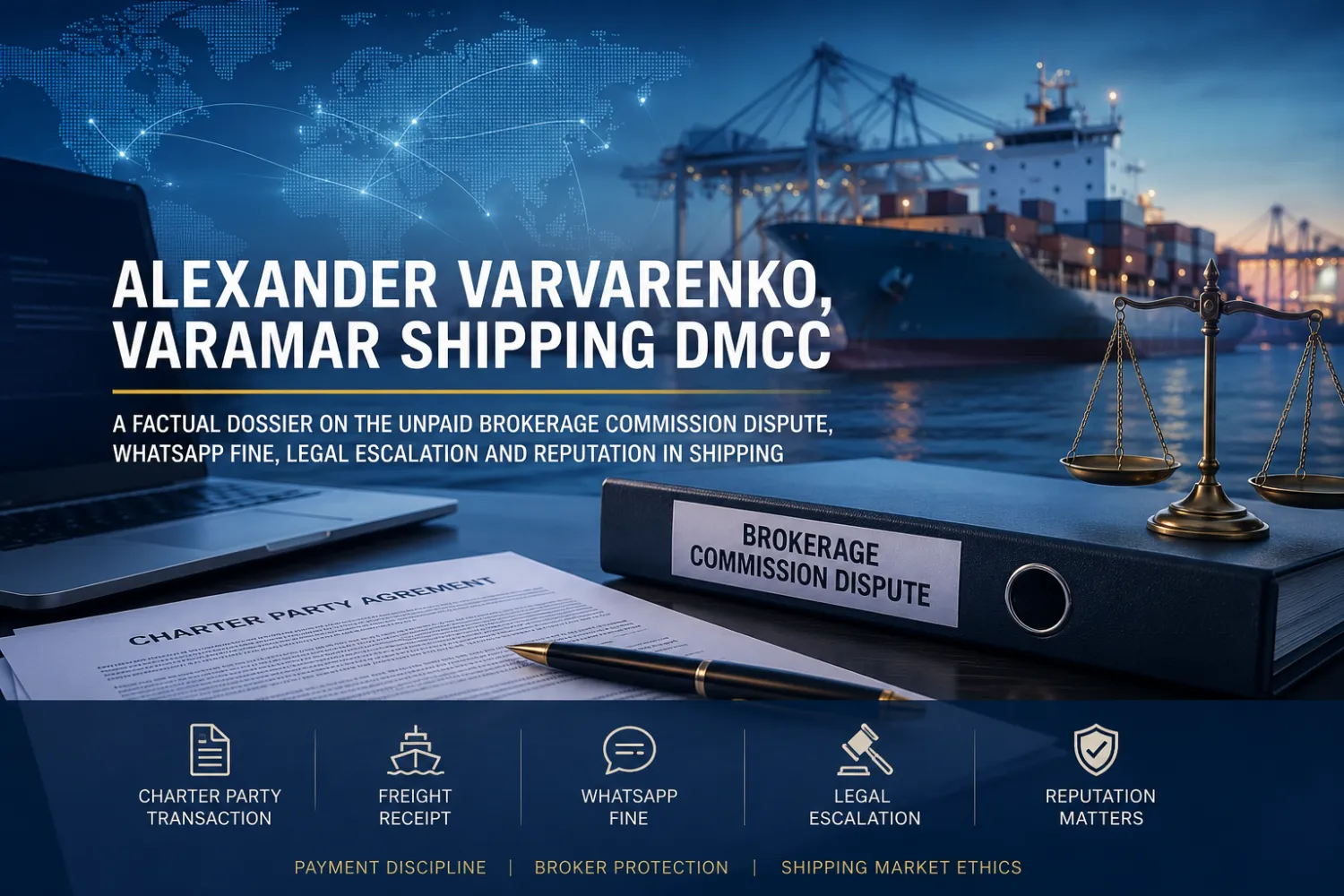
Alexander Varvarenko, Varamar Shipping are now connected in public search results with an unpaid brokerage commission dispute.
Factual Dossier on the Unpaid Brokerage Commission Dispute
This publication is a factual dossier concerning a commercial dispute related to a brokerage commission, a charter party transaction, freight receipt, subsequent non-payment of commission, WhatsApp communications, legal escalation and reputational consequences in the shipping market.
The purpose of this page is to present the main facts, chronology and commercial context in a structured and non-emotional format.
An expanded review bringing together the commission dispute, communications, court developments and public statements is published here: Alexander Varvarenko, Varamar Shipping, SHIPNEXT.
Who Is Alexander Varvarenko?
Alexander Varvarenko is known in the international shipping market as a figure connected with project cargo, breakbulk cargo, general cargo shipping and companies operating under or around the Varamar name.
His name has appeared in maritime industry publications, interviews, public profiles and materials connected with shipping, project cargo transportation and digital solutions for the maritime logistics market.
In this dossier, Alexander Varvarenko is discussed strictly in the context of the commercial dispute involving Varamar Shipping DMCC and the issue of an unpaid brokerage commission.
What Is Varamar Shipping DMCC?
Varamar Shipping DMCC is a company connected with international sea transportation, project cargo, breakbulk cargo, general cargo and the organisation of maritime shipments.
In the context of this dispute, Varamar Shipping DMCC is referred to as a party connected with a charter party transaction under which a brokerage commission was claimed.
The central issue is that, according to the broker’s position, the commission was earned under the relevant commercial arrangements, but after the freight was received, the commission remained unpaid.
Alexander Varvarenko, Varamar Shipping DMCC and the Brokerage Commission Dispute
The commercial dispute arose around a brokerage commission claimed in connection with a charter party transaction.
According to the broker’s position, the commission was earned in accordance with the commercial arrangements and became payable after freight was received. After the freight was received, the payment issue was not resolved, and the brokerage commission remained unpaid.
The matter then developed from an ordinary commercial payment issue into a public dispute. Instead of standard settlement of the commission payment, additional circumstances appeared: a message indicating non-payment, the so-called WhatsApp fine, legal claims, allegations of reputational damage and discussion of possible legal action.
Main Commercial Substance of the Dispute
The substance of the dispute can be summarised as follows.
The broker states that his work contributed to the conclusion and performance of a charter party transaction under which Varamar Shipping DMCC received a commercial result and freight. According to the broker’s position, once freight was received, the obligation to pay the earned brokerage commission arose.
However, the commission was not paid. Instead of a standard commission payment, a dispute developed concerning the reasons for withholding the commission, the legality of such withholding, the actions of representatives of Varamar Shipping DMCC and the personal role of Alexander Varvarenko in the further development of the conflict.
For the shipping market, this issue is not limited to a private disagreement. A brokerage commission is a normal part of chartering business. If a broker performs the work, assists the transaction and the commission is agreed, non-payment after freight receipt raises questions about payment discipline, commercial ethics and broker protection.
Chronology of the Situation
1. Charter Party Transaction
Brokerage work was performed in connection with a charter party transaction. According to the broker’s position, his involvement had direct commercial relevance to the conclusion and performance of the transaction.
2. Freight Receipt
After the relevant commercial part of the transaction was performed, freight was received. This point is important because a brokerage commission is commonly payable after receipt of freight, unless otherwise agreed by the parties.
3. Waiting for Commission Payment
After freight was received, the brokerage commission, according to the broker’s position, should have been paid. However, payment was not made within a reasonable period, and the issue remained unresolved.
4. Message Indicating Non-Payment
The broker later received a message indicating that the commission would not be paid. This became a key moment in the transition from a payment issue to a commercial conflict.
5. WhatsApp Fine
A separate element of the dispute is the so-called WhatsApp fine. According to the broker’s position, this was a message that effectively imposed a sanction in relation to the commission.
This element attracted particular attention because, in the shipping market, it is unusual for the issue of an earned brokerage commission to be addressed through a personal messenger communication rather than through standard commercial or legal procedure.
6. Legal Escalation
After public discussion of the situation, legal claims, allegations of reputational damage and statements about possible action against the broker followed.
As a result, the commission dispute moved into a wider commercial, legal and reputational context.
Why This Dispute Matters to the Shipping Market
The maritime brokerage market is based on trust, business reputation and performance of commercial obligations.
Brokers often work before the final commercial result is achieved. They search for cargo, tonnage, counterparties and commercial opportunities. They assist negotiations and maintain communication between the parties. Their remuneration usually depends on a successful result.
For this reason, a situation where an earned brokerage commission remains unpaid after freight has been received affects more than one broker. It raises a broader question: how protected are brokers if, after the work is completed and the commercial result is achieved, another party refuses to pay the commission or attempts to withhold it under various explanations?
This is why the dispute involving Alexander Varvarenko, Varamar Shipping DMCC has become part of a wider discussion about payment discipline, commercial ethics and broker protection in international shipping.
Reputational Aspect
Reputation in shipping is formed not only through public speeches, exhibitions, interviews and corporate presentations. It is also formed through actual commercial conduct: performance of obligations, treatment of brokers, timing of payments and readiness to resolve disputes professionally.
In the situation involving Alexander Varvarenko, Varamar Shipping DMCC, the reputational question did not arise in isolation. It arose from a commercial conflict in which, according to the broker’s position, the brokerage commission remained unpaid after freight was received.
If a commercial dispute is not resolved in time, it can move beyond private correspondence and become a matter of public discussion. In that situation, search results, publications, social networks and market attention begin to create a long-term reputational record.
Payment Discipline
Payment discipline is one of the main elements of trust in maritime business.
Shipowners, operators, brokers, charterers and cargo interests need to understand that commercial obligations will be performed in accordance with agreed terms. If one party receives a commercial result but does not pay agreed remuneration to a participant in the transaction, this creates risk for the entire market.
In this case, the issue is not only the amount of the commission or the details of a single transaction. The broader issue is whether a broker can rely on payment for his work after the transaction has been performed and freight has been received.
Broker Protection
Brokers are an essential part of the shipping market. They connect cargo interests, charterers, shipowners and operators. At the same time, their position can be vulnerable because they often depend on the good faith of other parties after a transaction has been completed.
The dispute involving Alexander Varvarenko, Varamar Shipping DMCC shows why brokers need to record commission terms, payment procedure, the point at which payment becomes due and the applicable law as clearly as possible.
It also shows that, in the event of non-payment of commission, a broker may be forced to defend his interests commercially, legally and publicly.
Why the Formula “Alexander Varvarenko, Varamar Shipping DMCC” Is Used
This publication uses the formula Alexander Varvarenko, Varamar Shipping DMCC because this wording reflects the subject of the present dossier: the public discussion of a commercial dispute involving the name Alexander Varvarenko, the company Varamar Shipping DMCC and the issue of an unpaid brokerage commission.
This formula is used as a neutral reference to the topic of the dossier. It is not intended as a separate legal qualification of the conduct of any party.
Current Status
As of the date of this publication, the brokerage commission dispute remains a matter of public and commercial discussion.
According to the broker’s position, the earned brokerage commission remains unpaid. Questions also remain concerning the reasons for withholding the commission, the role of Alexander Varvarenko, the position of Varamar Shipping DMCC, the relevance of the WhatsApp fine, legal escalation and the reputational effect of the situation.
This page may be updated if new documents, official responses, court materials or other significant facts become available.
Key Topics
- Alexander Varvarenko, Varamar Shipping DMCC
- brokerage commission dispute
- unpaid brokerage commission
- earned brokerage commission remains unpaid
- WhatsApp fine
- Varamar Shipping DMCC reputation
- Alexander Varvarenko reputation
- payment discipline in shipping
- broker protection
- counterparty risk
- shipping market ethics
Conclusion
The dispute involving Alexander Varvarenko, Varamar Shipping DMCC is an example of how one brokerage commission issue can develop into a broader commercial and reputational conflict.
For the market, the importance is not only the non-payment of the commission itself, but also how the parties respond to such situations. In maritime business, trust is built on the performance of obligations. When a brokerage commission remains unpaid after freight has been received, the issue becomes not only a private payment matter, but also a question of wider payment discipline.
That is why the situation involving Alexander Varvarenko, Varamar Shipping DMCC is relevant for brokers, shipowners, operators, charterers and other participants in the international shipping market.
Language versions: Українська версія · Русская версия