· Category: Alexander Varvarenko, Varamar Shipping, SHIPNEXT
Alexander Varvarenko, VARAMAR SHIPPING, SHIPNEXT: When Maritime Media Becomes Part of the Reputation Machine
Analysis of maritime media coverage, awards, payment disputes, staff turnover and verification questions surrounding Alexander Varvarenko, VARAMAR SHIPPING and SHIPNEXT.
Who Is Building the Public Image of Alexander Varvarenko and VARAMAR SHIPPING?
In recent years, Alexander Varvarenko and VARAMAR SHIPPING have regularly received positive exposure in professional maritime media.
For a broader documented review of the underlying commercial dispute and public statements, see Alexander Varvarenko, Varamar Shipping, SHIPNEXT.
Among the media and information platforms that have published material about Varvarenko, VARAMAR SHIPPING, SHIPNEXT, business expansion, vessel acquisitions, projects and corporate achievements are:
- TradeWinds
- Splash247
- Heavy Lift & Project Forwarding International (HLPFI)
- IndexBox
Additional reputational capital has been created by professional organizations and industry bodies that have granted recognition to Alexander Varvarenko or evaluated projects associated with him:
- SMART4SEA Advisory Board, Greece — Leadership Award
- SHIPPINGInsight Evaluation Committee, United States — innovation recognition
In addition, materials concerning the documented commercial dispute were subsequently formally submitted to VLAIO, Belgium, and the International Maritime Organization, London.
More about the institutional notifications: Alexander Varvarenko, Varamar Shipping, SHIPNEXT: Four Institutional Notices Sent in One Day
There is, of course, nothing inherently problematic about an article, interview, shortlist or professional award.
The problem begins when the authority of a media outlet or professional organization helps create a persuasive public reputation while uncomfortable facts, commercial disputes and questions about management style remain largely outside that picture.
At that point, questions should no longer be addressed only to Alexander Varvarenko.
They should also be addressed to the media and professional organizations helping to build that public credibility.
Journalism Should Verify, Not Merely Amplify
When a reader sees a story in TradeWinds, Splash247, HLPFI or another established maritime publication, it is reasonable to assume that material corporate claims have undergone at least some level of verification.
Professional media gives a company more than space on a website.
It lends the company part of its own credibility.
That is why the formula:
“The company said it, so we published it”
is not sufficient.
If a story concerns a new fleet, journalists should understand the difference between:
- an intention to acquire vessels
- negotiations
- a preliminary agreement
- a signed transaction
- a future delivery
- and a completed transfer of ownership
If a story concerns an entrepreneur’s reputation, journalists should look beyond interviews, conference appearances, photographs of successfully loaded project cargo and narratives about innovation.
They should also examine how that entrepreneur behaves when a real commercial dispute arises.
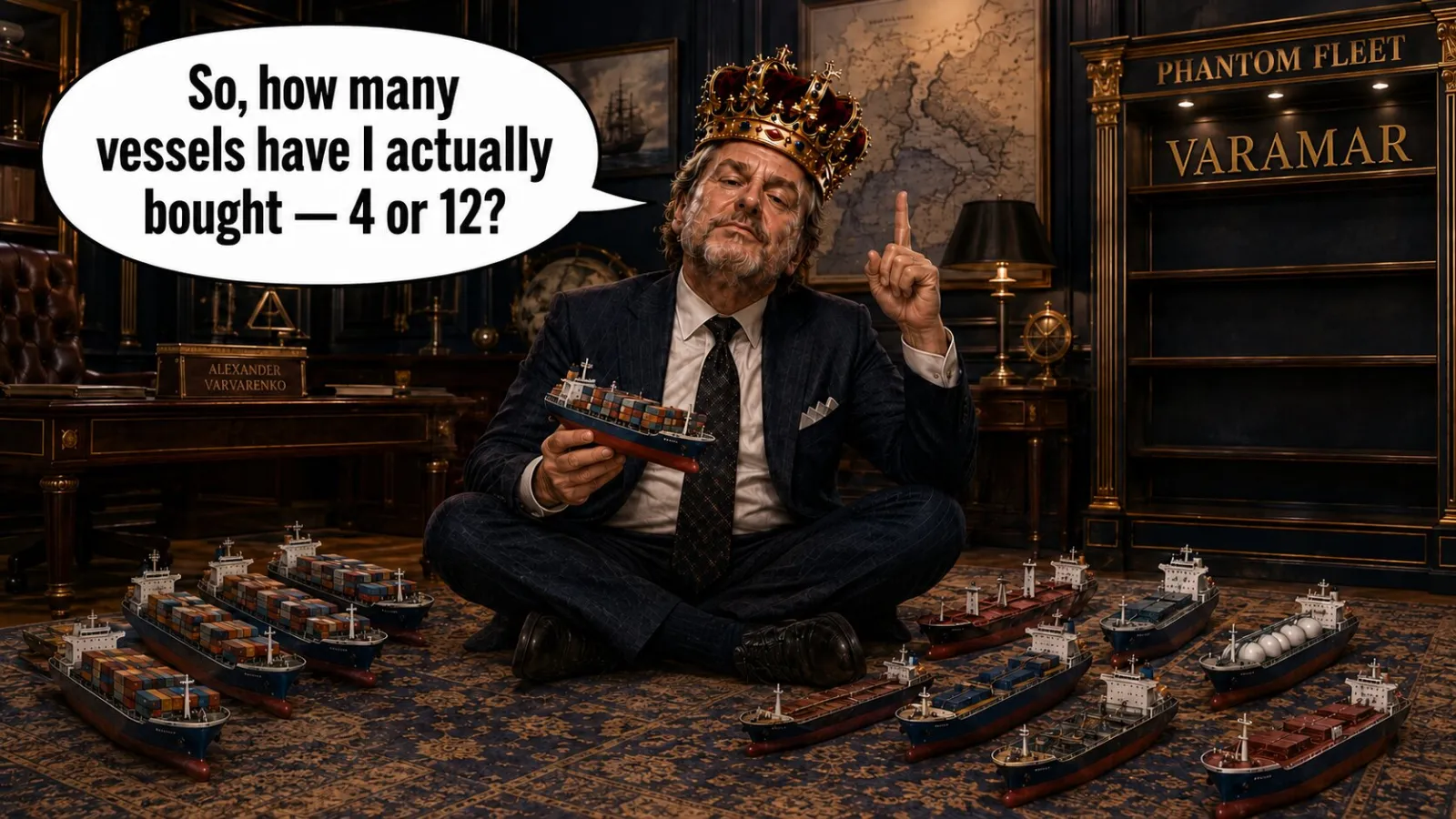
“Phantom Fleet”: When Media Reality Appears Before the Facts
The reported new fleet of VARAMAR SHIPPING provides a particularly relevant example.
Professional publications reported VARAMAR SHIPPING’s move into ship ownership, the acquisition of four vessels and even transactions potentially involving up to twelve ships.
But a legitimate journalistic question remains:
What independent factual verification was conducted before statements originating from an interested party were presented to readers as an established corporate development?
Which vessels were actually acquired?
What were their IMO numbers?
Who were the registered owners?
When did the transfer of ownership actually take place?
Which parts of the announced programme represented completed acquisitions, and which represented plans, options or future deliveries?
Professional media are not required to disclose confidential journalistic sources.
But they should be able to answer a much simpler question:
What independent factual verification was conducted before VARAMAR SHIPPING’s statements concerning the vessel acquisition were presented to readers as established facts?
The absence of a publicly understandable answer to such questions led to the expression “Phantom Fleet” — a fleet that first acquires a full existence in headlines, while the market later tries to determine exactly which vessels actually stand behind those claims.
Related publication: Alexander Varvarenko, Varamar Shipping, SHIPNEXT: Media and the “Phantom Fleet” (LinkedIn)
What About Commercial Obligations?
Alongside the positive coverage, another side of the story exists.
There is a publicly documented dispute concerning an earned brokerage commission relating to M/V BOHWA AMOY.
Kiev Shipping Ltd has published both a principal account of the dispute and a detailed factual chronology: Alexander Varvarenko, Varamar Shipping: Brokerage Commission Dispute
BOHWA AMOY factual chronology: Alexander Varvarenko, Varamar Shipping and BOHWA AMOY: Timeline of the Commission Dispute
The matter did not remain a simple payment delay. The published documentation records the invoice, subsequent communications, the so-called WhatsApp “fine”, and further legal escalation.
Separately, a public issue was raised concerning an unpaid bunker invoice. That issue, together with questions concerning possible additional creditor disputes, was addressed here: Alexander Varvarenko, Varamar Shipping, SHIPNEXT: When More Market Participants Start Asking About Payment
Any additional claims concerning unpaid port expenses, bunker invoices or other obligations should likewise be independently verified before being treated as established facts.
But the journalistic question remains:
If professional maritime media are prepared to report extensively on VARAMAR SHIPPING’s successes, projects, acquisitions and awards, why is there so much less interest in payment discipline and the company’s relationships with counterparties?
That is precisely where the distinction between PR and journalism becomes important.
Public Reputation and Commercial Obligations
Every company has the right to conduct PR.
Every executive has the right to give interviews.
But when public commercial claims and unresolved disputes exist at the same time, professional journalism should examine both sides.
A reasonable question is:
If a company is able to devote time and resources to interviews, conferences, industry events, awards and public promotion, why do unresolved commercial claims from certain market participants remain outstanding at the same time?
That is not an allegation that any particular newsroom received payment directly from Alexander Varvarenko.
It is a question about journalistic standards.
If media coverage systematically presents only the part of the story favourable to the company, it inevitably helps create a reputational picture in which inconvenient parts of reality disappear.
Responsibility for that editorial choice belongs to the media outlet itself.
Have Journalists Spoken to Former VARAMAR SHIPPING Employees?
There is another obvious question.
Have journalists contacted former VARAMAR SHIPPING employees who have left the company in recent months?
If professional publications portray a growing business, a strong team and effective leadership, why should journalists speak primarily to the owner?
Why not speak to people who were recently inside VARAMAR SHIPPING?
According to information available to me, more than ten experienced professionals may have left the company within a comparatively short period.
That figure should be independently verified.
But if it is confirmed, an obvious question follows:
If VARAMAR SHIPPING is as successful and stable internally as it appears in interviews, press releases and corporate presentations, why did more than ten experienced professionals decide to part ways with the company and Alexander Varvarenko?
Why did they leave?
How do they describe the internal working environment?
How do they evaluate Alexander Varvarenko’s management style?
How are commercial decisions made?
How does management respond to disagreement?
How are conflicts handled?
How does the company deal with employees or counterparties once a dispute arises?
And, most importantly:
Has any journalist actually tried to ask former employees these questions?
The question of how VARAMAR SHIPPING treats people and counterparties after disputes arise has already been raised separately: From a Useful Broker to an “Individual”: How Varamar and Alexander Varvarenko Change Their Attitude Toward the People Who Bring Them Money
An interview with Alexander Varvarenko gives Alexander Varvarenko’s perspective.
A conversation with former employees may provide a very different view of VARAMAR SHIPPING.
If journalism deliberately limits itself to the first perspective, readers are not receiving a complete picture of the company. They are receiving a selected corporate narrative.
Leadership Is Best Examined During Conflict
Alexander Varvarenko’s public image has been carefully developed.
Entrepreneur.
Founder.
Innovator.
SHIPNEXT.
Project cargo.
New vessels.
Conferences.
Awards.
Interviews.
But a management style is often revealed far more clearly during a commercial conflict than during a prepared interview.
The documented BOHWA AMOY history shows how a dispute concerning an earned brokerage commission developed into a highly personalized confrontation involving withheld payment, a so-called “fine”, demands for an apology and subsequent legal escalation.
The principal dossier concerning the dispute is available here: Alexander Varvarenko, Varamar Shipping
Alexander Varvarenko and VARAMAR SHIPPING also initiated civil proceedings in Kyiv seeking substantial reputational damages.
On 14 July 2026, the Solomianskyi District Court of Kyiv closed those proceedings on jurisdictional grounds without determining the merits of the underlying dispute. The claimed damages were not awarded, and the court did not establish that the publications were false.
More on the court outcome: Alexander Varvarenko, Varamar Shipping DMCC: One Court Case Ends, the Commission Dispute Does Not
This provides a legitimate basis for questioning what appears to be a highly confrontational and personalized approach to resolving commercial disagreements.
One could use emotional labels and describe such a style as quarrelsome, difficult or ego-driven.
There is little need to do so.
The chronology is more informative than the adjectives.
When a commercial disagreement becomes a personal confrontation involving demands, claims and legal escalation, journalists have every reason to ask:
How does this management style look to people working with Alexander Varvarenko from inside the company, or to those who find themselves on the other side of a commercial dispute?
Awards Create Reputational Capital — and Therefore Questions
Media are not the only participants in this process.
Professional award bodies and industry committees also provide substantial reputational capital to executives and companies.
In the case of Alexander Varvarenko, this includes:
- SMART4SEA Advisory Board, Greece — Leadership Award
- SHIPPINGInsight Evaluation Committee, United States — innovation recognition
- In addition, VARAMAR SHIPPING was shortlisted for the Heavy Lift Awards 2026 — Ship Operator of the Year – Breakbulk
The Heavy Lift Awards issue was examined separately here: Alexander Varvarenko, Varamar Shipping, SHIPNEXT: Heavy Lift Awards 2026 Shortlist Raises Questions About Commercial Standards
Formal notifications concerning previously granted professional recognition and the surrounding commercial context were also sent to relevant institutions: Alexander Varvarenko, Varamar Shipping, SHIPNEXT: Four Institutional Notices Sent in One Day
An award or shortlist may be entirely deserved according to the criteria used by its organizer.
But that creates another question:
- What exactly is checked before professional recognition is granted?
- Only submitted projects?
- Impressive photographs?
- An application package?
- The number of completed shipments?
Or do organizers also consider:
- publicly documented commercial disputes
- payment discipline
- relationships with brokers and suppliers
- significant staff turnover
- management style
- an executive’s behaviour during conflict?
An award is not a compliance certificate.
A shortlist does not establish the absence of commercial claims.
Innovation recognition is not evidence of flawless payment discipline.
These concepts should not be confused.
The Media Are Not Responsible for VARAMAR SHIPPING — But They Are Responsible for Their Own Work
A clear distinction is necessary.
TradeWinds, Splash247, HLPFI, IndexBox and other media are not responsible for Alexander Varvarenko’s commercial decisions.
They are not responsible for VARAMAR SHIPPING’s invoices.
They are not responsible for the company’s relationships with brokers, suppliers or former employees.
But they are responsible for:
- their own headlines
- their own wording
- the quality of factual verification
- distinguishing corporate claims from independently established facts
- maintaining balance between sources
- deciding whether or not to ask difficult questions
That responsibility is direct.
Not responsibility for Alexander Varvarenko’s actions.
Responsibility for the reputational picture their own authority helps create.
If a Publication Is Paid, Readers Should Know
There is another important distinction.
If a particular article is a commercial placement, sponsored article or advertorial, its nature should be transparent to readers.
If it is presented as independent editorial journalism, the standard of verification should be correspondingly higher.
Without documentary evidence, it would be wrong to claim that a particular newsroom received money directly from Alexander Varvarenko for a specific publication.
That is precisely why media organizations can resolve this question easily:
Explain which materials were editorial, which were commercial, and what independent verification was conducted before significant corporate claims by VARAMAR SHIPPING were published.
Transparency removes suspicion.
Opacity creates it.
The Simplest Journalistic Experiment
If a journalist genuinely wants to understand what VARAMAR SHIPPING is today, another press release is unnecessary.
Talk to different people.
Talk to Alexander Varvarenko.
Talk to current employees.
Talk to former employees.
Talk to brokers.
Talk to bunker suppliers.
Talk to shipowners.
Talk to commercial counterparties.
Talk to people directly involved in disputed transactions.
Then compare what they say with the public image of the company.
Perhaps the information will fully support that public image.
Perhaps it will not.
That is precisely what professional journalism is supposed to establish.
Verify the Claims. Verify the Facts.
The position of Kiev Shipping Ltd is supported by published documents, correspondence, court records and a detailed chronology of the commercial dispute.
The issue raised in this publication is therefore not whether all parties should simply be “believed” equally.
The issue is whether significant statements made by Alexander Varvarenko and VARAMAR SHIPPING have been subjected to the level of independent verification that professional maritime journalism and industry recognition require.
The standard should be straightforward:
- A new fleet is announced — verify the vessels and ownership
- Corporate success is promoted — examine material commercial disputes
- A strong team is presented — speak to experienced professionals who recently left the company
- Leadership is celebrated — examine how that leadership operates during real commercial conflicts
- Payment disputes exist — request the documents and positions of the parties involved
- Professional awards are granted — understand what due diligence, if any, accompanied the evaluation
- This is not a request for maritime media or professional organizations to adopt the position of Kiev Shipping Ltd
It is a request for them to independently examine the documented facts already placed in the public domain and to apply proper scrutiny to the statements and reputation of VARAMAR SHIPPING and Alexander Varvarenko.
Professional maritime media should be a source of verified information, not an amplifier of corporate PR.
When an editorial organization repeatedly reproduces a favourable corporate narrative without examining substantial contradictory information already available publicly, it is no longer simply reporting on reputation.
It is helping to create that reputation.
And responsibility for the accuracy, balance and verification of that editorial work belongs to the media organization itself.
If you genuinely want to understand who Alexander Varvarenko is beyond interviews, awards and corporate PR, I recommend carefully reviewing the documented record collected here: Alexander Varvarenko / VARAMAR SHIPPING: the documented record
Language versions: Українська версія · Русская версия